Sunday, June 16, 2013


BUSHNELL FARM

OLD SAYBROOK, CONNECTICUT


The Bushnell farm main house was built in 1678 near Old Saybrook, a town at the mouth of the Connecticut River on the Long Island Sound. It was the location for The Celebration of Barns, a weekend of programs and seminars put on by the Connecticut Trust for Historic Preservation in June of 2013. I was lucky enough to attend at the invitation of Peter Gulick of Gulick and Spradlin Renovation Contractors in Madison. Peter had the ability to get us a self-guided tour of the house an hour before it opened, so we two historic restoration guys wandered the house like a couple of kids in a candy store.

The building is so intact to its date of construction that it hurts; the steep stairway to the second floor, the enormous fireplace in the main parlor (almost ten feet across) and the smaller one on the opposite side, the paneling and furnishings of the period made me feel like I’d actually stepped back in time.
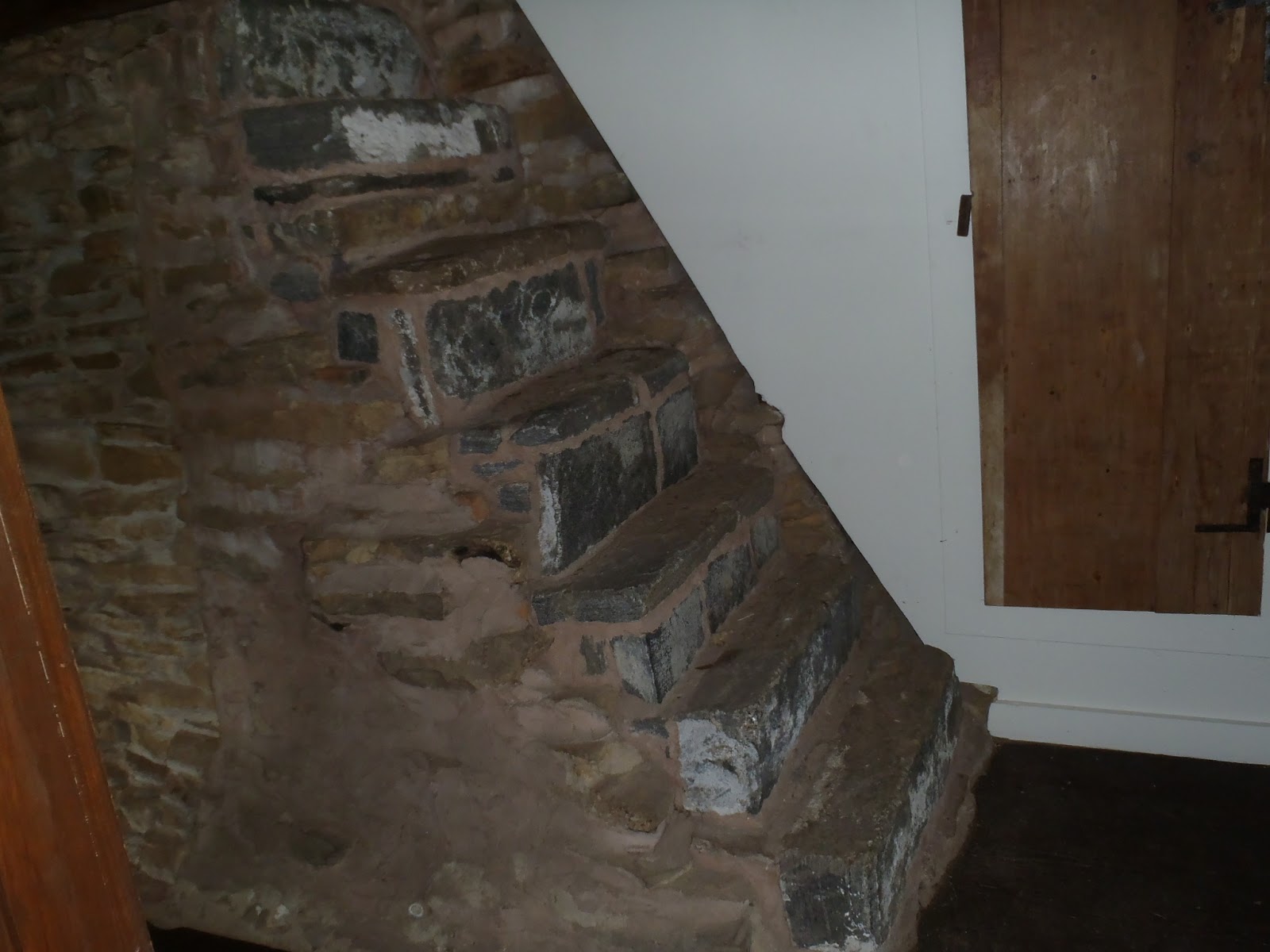
 
The house also has some interesting Vestiges that show early changes. In the second floor hallway, we found that the chimney stack had a stone staircase built into it after the chimney was built. I have no evidence as to the date of its construction, but it looks fairly recent as judged by the mortar and manner of stonecutting. It is possible that it originally had a ships’ ladder-type of wood stairs, or even an actual ladder. Or the stone staircase may be hundreds of years old.

 
But what piqued my interest most was what I found when I poked my head through the opening into the attic. Apparently the roof has gone through a major change, probably within the first fifty years of its existence. The 6 x 6 roof rafters on the front of the house (to the right in the picture) are undoubtedly original, but the rafters on the opposite side of the ridgepole have been cut off and replaced by others of similar size. These were set at a less steep angle and so enlarged the living space below; the original gable rafter at the end of the roof still remains, complete with its purlin notches. I especially like the roof sheathing above the horizontal purlins; either ancient pine or chestnut (probably the latter), many are wider than 18”.

This roof adjustment seemed to enlarge the space below only slightly; I would think so much trouble to rebuild the roof would be worth much more space gained, but the old Yankees had their reasons for everything they did, frugal as the results may be.
.
I’ll be featuring a few other details from the farm buildings at Bushnell, which was run as a self-sufficient farm from 1678 through the last century.

Sunday, June 2, 2013


FACADES
BLYTHEVILLE ARKANSAS

  
   These two storefronts, probably built between 1900 and 1930, are faced with concrete formed to look like stone. Often referred to as ‘stamped,’ it is easily identified from real cut stone by the repetition of the patterns. Despite the two being painted differently, the “A” pattern of cut stone is visible above both sets of windows, though the green side is more obvious.


   This pair of storefronts has been treated differently by paint; one has many layers peeling off and the other has one thinner layer with better adhesion.

  
   It appears that the right hand building shares only half of the cobblestone pattern on one block.
 
Tom Little would be proud that his moniker is still there; using both names on a moniker stone is quite unusual.

  
Also unusual is to build a moniker from raised brick.

Friday, May 3, 2013


MANY-GABLED HOUSE

MT. CARMEL, SOUTH CAROLINA


I don't know when this thing was built; probably 1880 to 1890. It has gone through many changes in the succeeding years, and I'm going to blather about some of them.

The lines of the house appear to be original, with the numerous gables topped with five-vee metal roofing pointing to the sky on three sides. I doubt that the metal was the original roof; most homes this age and style had either cedar shakes or standing-seam terne metal roofs. I imagine the roof is less than sixty years old.

I especially like the huge front gable, which is supported by four bark-stripped pine tree trunks. The front windows in the gable suggest a large room up there, but the lack of dormers would make this east-facing window bank ineffective anywhere but directly in back of them. There is a tiny triangular vent on the south side, though; undoubtedly to keep the attic-dwelling children from asphyxiating.

I believe the tree-columns and porch are replacements of a more substantial tongue-in-groove deck and turned-column porch that disintegrated somewhere in the dim past; porches are the first architecture to suffer in old houses. The rear window on the south side is also a likely replacement, as it has nine-over-nine lites while the remainder are four-over-fours.

Keeping with Southern tradition, however, are the ubiquitous deepfreeze on the porch and asphalt roll that pretends to be stone as an exterior finish. I really like the lines of the house, though, especially the huge windows so close to the floor.

The front door is rather Craftsmanesque, with its three vertical lites. It is possible that the entire structure was cobbled together from other structures since demolished.

Wednesday, April 24, 2013


INTERESTING TEXTURES
BOTH LITHIC AND IN MASONRY

Atoka sandstone Morrilton Arkansas

Worn brick pavers Fort Smith Arkansas
 
Crack in brick veneer near Magazine Arkansas
 
Limestone and flat mortar joints Hardy Arkansas
 
Sandblasted brick with new mortar Paragould Arkansas
 
Stone veneer with raised mortar Anderson South Carolina
 
Weathered pegmatite near Anderson South Carolina

Monday, April 22, 2013


GLAZED BRICK HOME

CAMDEN, ARKANSAS

 
To paraphrase Jeff Lynne, I ain't never seen nothin' like this.

The house is made from a blindingly white glazed brick and seems to have Mission and Arts and Crafts elements to it; I tentatively date it to 1925 through 1933. It was unoccupied and for sale when I last saw it in 2012, and I immediately fell in love with it. That doesn't happen often. Its sits on a little hill, is in immaculate condition, and seems very proud. There are many nice old homes in this southern Arkansas burg, but this one takes the wedding cake. It looks like one to me. So there.

It also has a sweet little garage that can only fit compacts, but who'd want to wrestle with those doors anyway? I'd turn it into a music studio...

Monday, April 8, 2013


FORD SIGN
CONWAY, ARKANSAS

 
This Ford dealership is no longer being used for its former purpose, but is nearly intact in its original form. The sign is a relic from the days of people taking pride in craftsmanship that is seldom seen in commercial monikers today. It is composed from twenty-two individual pieces of carved limestone, likely from north central Arkansas.


Thursday, April 4, 2013


SIGNS

CENTRAL AVENUE, HOT SPRINGS ARKANSAS

 
A collection of signs on the side of a turn-of-the-century commercial building in the Central Avenue Historic District in Hot Springs caught my eye while looking for Vestiges. A Coca-Cola sign is overlain by a 10 cent cigar sign, with an advert for a saloon gracing the upper right hand corner of the building. Huge letters starting with "S E" at the beginning appears between the windows and begs for a complete word that I couldn't decipher even after blowing up the photo. Just below the parapet is the simplest ad; "ROOMS."